
 Bulgaria
  Greece
  Turkey
  Romania
  Serbia
  N. Macedonia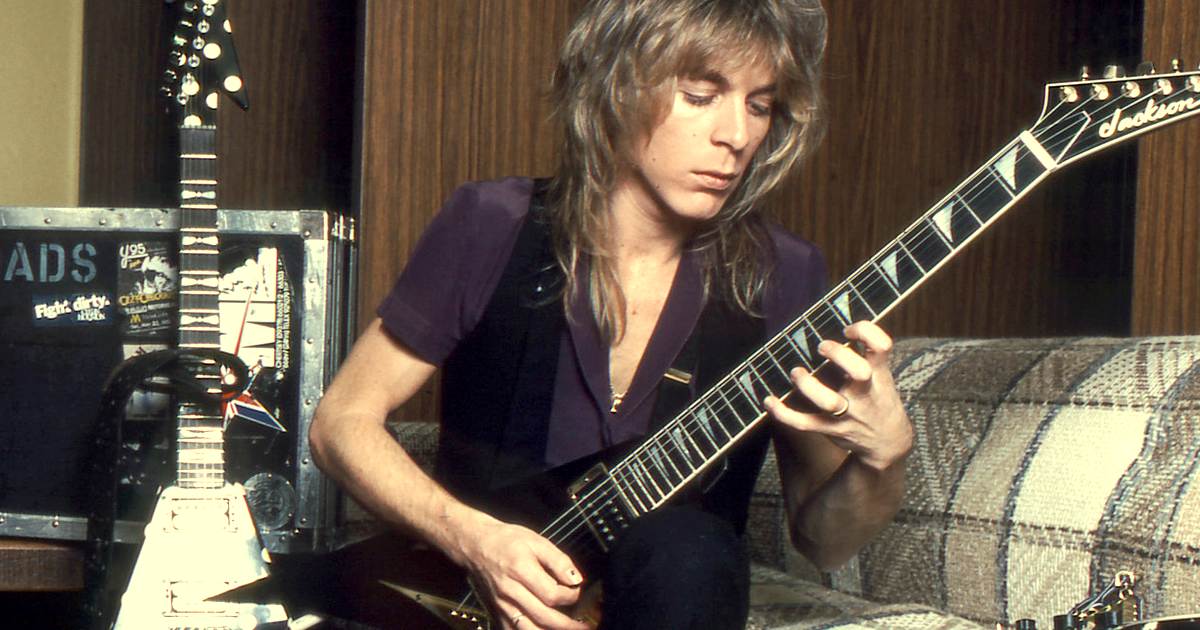
Randy Rhoads is one of the brightest and shortest-lived phenomena in the history of rock music. Known first with Quiet Riot, and then as Ozzy Osbourne's guitarist, he left a legacy that far exceeds the number of recorded albums. With just two studio albums with Ozzy – Blizzard of Ozz (1980) and Diary of a Madman (1981) – he had an enormous influence on an entire generation of guitarists. His tragic death in 1982, at just 25, cut short a career that would likely have changed the development of rock guitar even further.
Rhoads combined three seemingly different traditions – classical music, hard rock, and the emerging heavy metal. What set him apart was his incredible musical discipline. While many guitarists of his generation relied primarily on the blues, Randy brought the thinking of a classical musician. His solos sound like carefully constructed compositions, not random improvisations.
His tone is bright, clear, tight, highly concentrated in the mid-frequencies, and exceptionally good at cutting through the other instruments. He uses relatively moderate distortion, which allows every note to remain distinct.
His main equipment includes a Gibson Les Paul Custom, Jackson Concorde (the prototype of later Jackson models), and Marshall amplifiers. Even in very fast passages, every note remains clearly distinguishable.
His string bending is very precise – he reaches the target pitch exactly, never sounds accidental, and often emphasizes the climax of the musical phrase. With him, there is no unnecessary demonstration – everything serves the melody.
His vibrato is relatively fast, tight, and very controlled. It is not as wide as Hendrix's or Gary Moore's, but it gives exceptional power to long notes. He uses legato (connected playing through hammer-on and pull-off) very naturally – for him, it serves not to demonstrate technique but the smoothness of the melody.
Here his serious classical preparation is also evident – he uses arpeggios, classical sequences, harmonic minor, diminished chords, and motifs inspired by baroque music. Later, these ideas would be further developed by Yngwie Malmsteen.
Rhoads is known for exceptional clarity and consistent alternate picking – even at high speed, he rarely loses clarity. This is one reason his solos sound so 'ordered.'
Although often remembered for his solos, Randy is also an excellent rhythm guitarist. His riffs combine weight, movement, and melodiousness – particularly impressive are Crazy Train, Over the Mountain, Believer, and I Don't Know. He never lets rhythm guitar be just accompaniment.
In soloing, Rhoads is exceptional. His solos have a clear beginning, development, climax, and logical end – he uses fast passages, melodic lines, pauses, classical motifs, and blues elements. The best part is that he never loses the melody, even in his most difficult passages.
Live, Randy does not improvise as freely as Hendrix – he prefers better-prepared solos, which then develop according to the moment. This gives his performance great stability.
Although his life was short, his compositional contribution is enormous. Without his ideas, songs like Crazy Train, Mr. Crowley, Revelation (Mother Earth), and Diary of a Madman would hardly sound the way we know them today. He showed that heavy music can be simultaneously aggressive and exceptionally musical.
Randy has almost no serious technical weaknesses. If we must be objective – he did not have the opportunity to develop his style over the following decades, so we cannot know where he would have gone as a musician. Also, he is not as free an improviser as Hendrix or Page – his strength is the exceptionally constructed composition.
Randy Rhoads is proof that great influence does not require a long career. In just a few years, he created a style that combined classical musical discipline with the energy of heavy metal in a way that inspired countless guitarists after him. Instead of impressing solely with speed, he built solos with dramaturgy, logic, and emotion – this is precisely why performances like Mr. Crowley and Crazy Train are still studied by guitarists around the world.