 Bulgaria
  Greece
  Turkey
  Romania
  Serbia
  N. Macedonia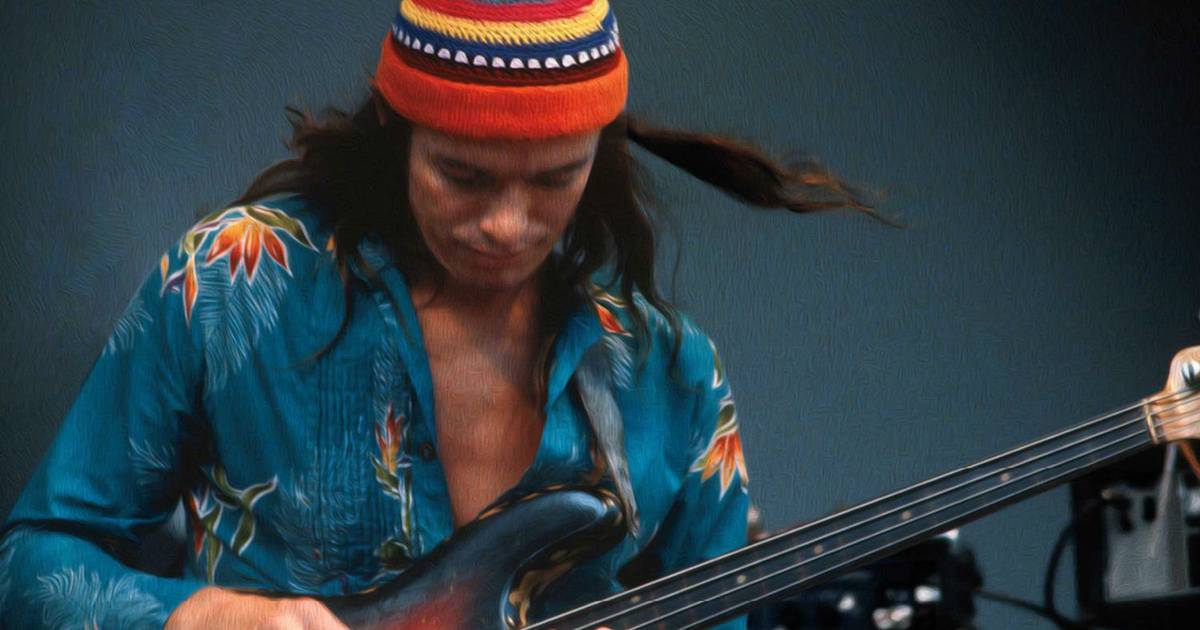
John Francis Pastorius III, known as Jaco Pastorius, was born in 1951 in Florida, USA. He started as a drummer but after a wrist injury turned to the bass guitar – this early experience as a drummer is probably one reason he possessed such an incredible feel for rhythm. In his youth, Jaco developed an almost obsessive attitude toward the instrument, spending countless hours in practice, experimentation, and searching for his own sound. And he found it – a sound no one before him had.
In 1976, his solo album Jaco Pastorius was released, one of the most influential albums in the history of the bass guitar. Later, he joined Weather Report, where he became one of the leading figures in jazz fusion. After Jaco, no one looked at the bass the same way.
He popularized the fretless bass and showed that the bass can play chords, perform harmonies, play harmonics, be a solo instrument, perform complex melodies, and improvise almost like a saxophone. This changed the history of the instrument.
Among his greatest influences are James Jamerson, Jerry Jemmott, Paul Chambers, Charlie Parker, John Coltrane, and classical music. He listened much more to saxophonists and jazz musicians than to bassists – and this is clearly reflected in his style, which is a blend of jazz, fusion, funk, Latin music, classical music, and improvisation.
His tone is probably the most recognizable bass sound in history – singing, clear, woody, mid-frequency oriented, almost vocal. On the fretless bass, notes slide smoothly into one another and create a sound that many compare to the human voice or cello.
His most legendary instrument is a standard Fender Jazz Bass, from which Jaco removed the frets and filled the slots, creating one of the most famous instruments in the entire history of music – nicknamed the 'Bass of Doom.' In doing so, he practically popularized the modern fretless electric bass.
The fretless bass is his trademark – without metal frets determining the exact pitch, the musician must intonate absolutely accurately, requiring exceptionally developed hearing. Jaco turned natural and artificial harmonics into a fundamental part of his style – while many bassists use them only as an effect, for him they became a musical language.
Before him, chordal playing on bass was rare – after him, it became standard practice. In improvisation, Jaco is a true phenomenon – he improvises with the thinking of a saxophonist, and his phrases often resemble a jazz wind instrument more than a bass guitar. He possessed enormous technique, but as with Hendrix, speed was never an end in itself – the musical idea was paramount.
His groove is often underestimated, but despite his virtuosity, Jaco has a phenomenal sense of rhythm – he can be simultaneously incredibly complex and exceptionally tight rhythmically.
Among his greatest performances are Portrait of Tracy (probably the most famous solo work for bass guitar – a true revolution), Donna Lee (one of the most difficult bass pieces ever recorded), Teen Town (perhaps the greatest bass line in the history of jazz fusion), Continuum (showing his incredible melodiousness), Birdland (an iconic performance with Weather Report), and Havona (one of the greatest bass parts ever written).
In addition to being a virtuoso, Jaco is also an excellent composer and arranger – his music combines jazz, rich harmony, rhythm, and orchestral thinking.
In comparison with other great bassists: with John Entwistle – Entwistle liberated the bass in rock, Jaco liberated it completely; with Jack Bruce – Bruce brought jazz thinking into rock, Jaco took it to a completely different level; with John Paul Jones – Jones is a great ensemble musician, Jaco is almost a separate musical universe; with Billy Sheehan – Sheehan is exceptional technique, Jaco is a revolutionary.
For objectivity – his style is so rich that it is not suitable for every type of music; he is not a bassist who seeks to remain unnoticed. But this is precisely why he is so unique. Jaco Pastorius is one of the few musicians of whom it can safely be said that they divide the history of the instrument into two eras – before him and after him. He proved that the bass can simultaneously be rhythm, melody, harmony, a solo instrument, and a means of absolutely free musical expression.