 Bulgaria
  Greece
  Turkey
  Romania
  Serbia
  N. Macedonia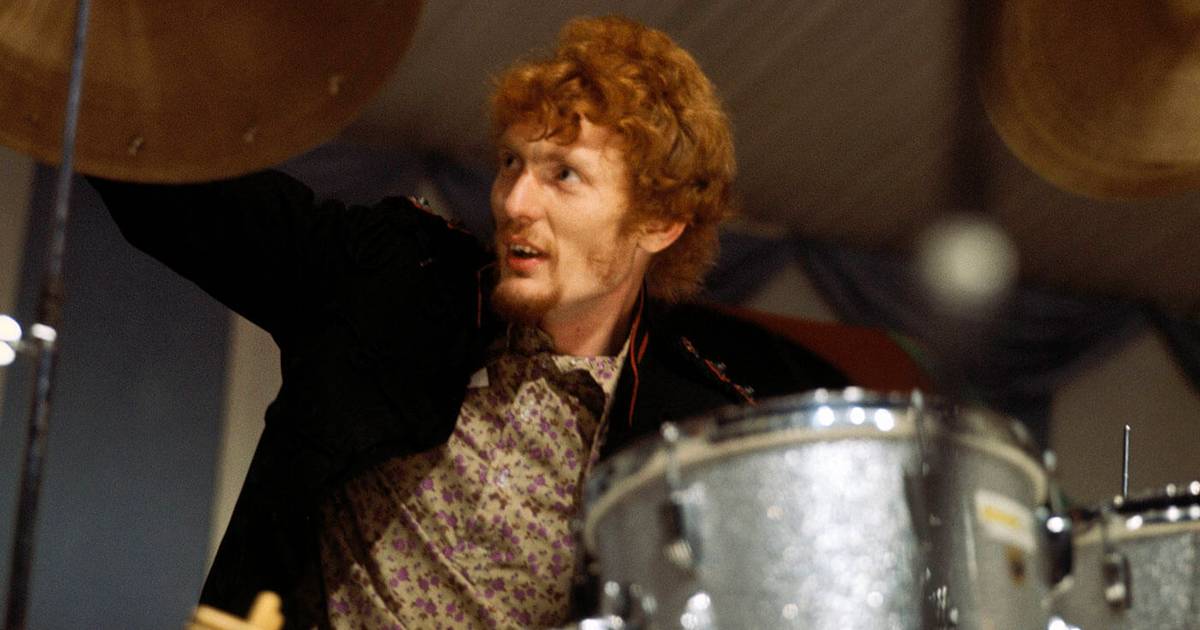
Ginger Baker is the third great drummer of that generation who completely changed the perception of what a rock drummer can do. If Bonham is power, and Keith Moon is chaos and energy, then Ginger Baker is jazz intellect and rhythmic freedom. He is the man who said: 'The drummer is not just someone who keeps the rhythm. He is a musician who creates rhythm.'
Peter Edward 'Ginger' Baker was born in 1939 in London, England. He got his nickname 'Ginger' because of his bright red hair. From a young age, he was drawn to jazz and began studying drummers from that scene. Among his greatest inspirations are Art Blakey, Max Roach, and Phil Seamen. African rhythmics had a particularly strong influence on him.
The real breakthrough came in 1966 when he formed Cream with Eric Clapton and Jack Bruce. This trio became one of the first true rock supergroups. Something revolutionary happened here – Cream had no classic structure: the guitar wasn't just lead, the bass wasn't just foundation, the drums weren't just rhythm. Everyone was a soloist.
Ginger Baker was one of the first rock drummers to show that drums could be complex, improvisational, melodic, and leading. Before him, many rock drummers thought primarily in four bars. Baker thinks like a jazz musician. He doesn't just count the song – he converses with the other instruments.
His style is a unique blend of jazz, blues, rock, African rhythms, and improvisation. Polyrhythms are one of his greatest strengths – the simultaneous use of different rhythmic patterns. This is very close to how jazz drummers think. Baker almost never plays mechanically – he constantly changes accents, transitions, and dynamics.
His sound is big, deep, open, and natural. He doesn't rely as much on enormous power like Bonham. His strength is in movement. His most famous kit is the Ludwig Drum Kit with two bass drums, multiple toms, and a large number of cymbals. He was one of the first drummers in rock to use a huge kit.
He was one of the pioneers of using two bass drums in rock, but he didn't use them for modern metal speed – he used them for different rhythms, accents, and dynamics. Baker has a very fluid way of playing – he doesn't constantly 'hit' the drums but moves them. He works with cymbals almost like an orchestral instrument – they create atmosphere, not just noise.
His interaction with Jack Bruce created one of the greatest rhythm sections in history. Jack Bruce is a bassist who plays like a soloist, and Ginger Baker is a drummer who also plays like a soloist. Sometimes they almost 'compete,' but it's precisely this tension that makes Cream so unique.
Toad is probably his most famous drum solo – one of the first rock drum compositions to become a legend. In concerts, it often lasted over 10 minutes. White Room is a perfect balance between power and complexity. Sunshine of Your Love shows that he can also be extremely musical.
For objectivity – Ginger Baker was often criticized for his difficult character, inconsistency, and sometimes excessive improvisation. As a drummer, he's also not 'ideally precise' in the classical sense. But his goal was never sterile accuracy.
The most important lesson from Ginger Baker: rhythm is not mathematics – it's a living organism. From him, we can learn to think musically, to develop limb independence, to listen to jazz, and not to fear experiments.
Ginger Baker is one of the few drummers who can be called a revolutionary. He didn't just play rock drums – he brought into rock the language of jazz, African rhythms, and free improvisation. If John Bonham shows how heavy drums can be, Ginger Baker shows how smart they can be. If John Bonham is thunder, and Keith Moon is an explosion, then Ginger Baker is a storm – complex, unpredictable, and constantly changing.